On this page
Baby laundry costs depend on the extra loads the household runs, how those clothes are dried and whether machines are paid for by the cycle. The baby does not necessarily create a second laundry system: adding small garments to an existing suitable load has a different cost from running a new wash and dryer cycle for them alone.
There is no single national baby-laundry bill. The comparison below uses ENERGY STAR’s published water benchmark and EIA’s electricity price, then labels all other worksheet inputs as assumptions. Replace those inputs with the appliance’s representative use, the utility tariff and the detergent dose before treating the result as a household budget.
Key figures
- 14 gallons ENERGY STAR washer water use per load
- 20 gallons Standard washer water use per load
- $80.89 Example: two extra loads weekly, per year
The published water benchmark is 14 versus 20 gallons
| Washer comparison | Published water per load | Water across 104 loads |
|---|---|---|
| Full-size ENERGY STAR certified washer | 14 gallons | 1,456 gallons |
| Standard washer in the agency’s comparison | 20 gallons | 2,080 gallons |
| Difference between those benchmarks | 6 gallons | 624 gallons |
Source note: ENERGY STAR Clothes Washers page, checked October 2026. Annual quantities multiply the published per-load benchmarks by an assumed two extra loads weekly for 52 weeks. They are not measurements of baby laundry or of a chosen wash program.
The agency also describes certified washers as using about 20% less energy and 30% less water than regular washers. Those comparison figures do not mean every baby’s laundry costs 20% less in an existing machine. Equipment, cycle, load and hot-water source still affect the energy purchased.
Water and sewer charges can be combined, separate or subject to minimum charges. Use the part of the rate that changes with consumption. A fixed monthly connection fee will not normally fall because the washer uses six fewer gallons in a cycle.
A home-load worksheet separates the consumable costs
For illustration, assume 2.5 kWh of purchased electricity for a wash-and-dry event, including the electric water-heating energy assigned to that event. At EIA’s July 2026 national residential average of 18.31 cents per kWh, that electricity costs about $0.46. This is a chosen energy input, not a published appliance-cycle measurement.
Now assume 14 gallons of water, with variable water and sewer cost totaling $0.005 per gallon. That adds $0.07. Add an assumed $0.25 detergent dose and the unrounded total becomes $0.77775, or about $0.78 per event. Stain treatment, machine wear and any separate fee are not included.
If gas supplies the hot water or dryer, account for that fuel separately instead of hiding it in an electric-only figure. Likewise, a washer energy label can include standardized water-heating and drying-related assumptions. Identify the label’s scope before adding those components again and counting the same energy twice.
The detergent input is bottle price divided by the number of doses supplied at the amount used. A nominal 100-load container does not give 100 loads if the routine uses twice the nominal dose. Follow the product and machine instructions; reducing the dose below instructions solely to lower a worksheet cost is not a cleaning plan.
Two extra loads weekly can mean $81 or $728 annually
At the example home’s unrounded $0.77775 per event, one extra weekly load costs about $40.44 over 52 weeks. Two cost $80.89, and three cost $121.33.
These figures describe the assumed additional routine, not every load the household washes after the baby arrives.
- One extra weekly load$40.44
- Two extra weekly loads$80.89
- Three extra weekly loads$121.33
This article's household worksheet: assumed energy, water and detergent inputs, using EIA's July residential electricity benchmark.
For a shared-machine sensitivity case, assume a posted $4 wash charge and $3 drying charge. The combined $7 fee means one extra weekly event costs $364 annually, two cost $728, and three cost $1,092. The fees are hypothetical, not a claim about national laundromat prices.
The difference between two weekly events in these examples is about $647.11 annually. It reflects two different cost structures, not a proven saving available to every household. Buying a washer to capture that difference would add equipment, installation, housing space and maintenance costs that the first comparison omits.
The baby clothing size guide connects laundry turnaround with the number of garments needed. More spares can reduce urgent tiny loads, but buying duplicates also costs money. Compare those purchases with the extra-cycle fees they might prevent instead of assuming either more clothes or more washing is always cheaper.
Ordinary clothes and cloth diapers have different routines
The American Academy of Pediatrics’ baby-clothes guidance, last updated in 2009, emphasizes durability, washability and garment care. It also explains that many parents wash baby clothes with family laundry without problems, rather than routinely needing a special baby-only detergent. That general observation does not override a garment label or individual pediatric guidance.
Keep heavily soiled items and cleaning instructions visible in the plan. A label that permits machine washing does not establish one temperature or cycle for every garment. A delicate outfit that repeatedly needs separate care has a different practical cost from an everyday washable bodysuit.
Cloth diapers are a separate cost comparison because their manufacturer’s washing system may call for several cycles and different handling. The cloth diaper total-cost guide covers equipment, supplies and that extra laundering. Do not import the ordinary-clothes example as the cost of a cloth-diaper batch.
Drying and laundry access can matter more than detergent
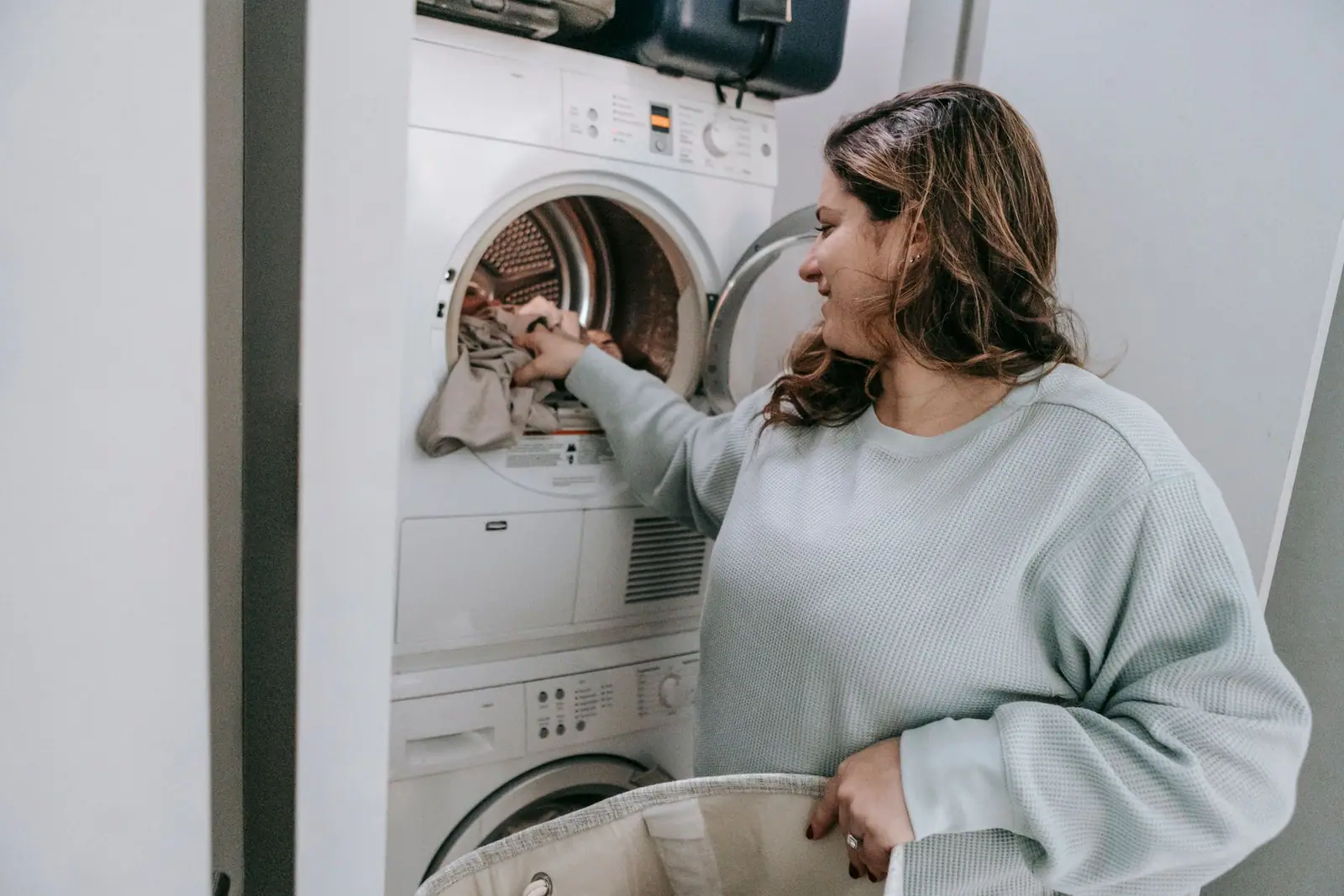
The worksheet’s electricity input includes drying, so line drying should replace that part of the input rather than subtracting an invented dryer saving from the final total. Humidity, available space, garment care and time until clothes are dry affect whether the change works.
For a dryer sensitivity case, assume 2 kWh per cycle at 18.31 cents. The electrical part is about $0.37 per drying cycle, or $38.09 for 104 cycles. That is not a prediction for a heat-pump, gas or standard resistance dryer; use the equipment’s representative consumption and the fuel purchased.
Account for access as well as utility use. A machine that is available only once weekly may require more spare clothes than an in-home washer. Shared-machine drying time can vary, so include the fees the household pays for a finished dry load rather than stopping the estimate at the washer.
Keep detergents secured out of children’s reach and follow product directions. AAP advises considering traditional detergent products instead of single-load packets in homes visited by children six or younger. For skin irritation, ask the baby’s clinician about care rather than treating a special detergent purchase as a diagnosis.
The budget becomes clearer after counting extra events for a representative week. Record which would have happened anyway, which are added for baby clothes, and which belong to diapers or bedding. That short record can answer the cost question more reliably than a generic annual laundry average.
The baby bath equipment budget separates the tub purchase from the towels that return to the laundry. Count those towels within the household load plan rather than charging for the same wash in both budgets.
Questions people ask
How much does two extra baby-laundry loads a week cost?
The assumed home example totals $80.89 over 52 weeks. The assumed $7 shared-machine wash-and-dry example totals $728. Replace energy use, detergent, water and cycle fees before applying either result.
Do baby clothes always need a separate wash?
AAP's general guidance notes that many families wash baby clothes with other laundry without problems. Follow the garment's instructions and individual care guidance; cloth diapers need their own manufacturer-directed routine.
Does a washer's 14-gallon benchmark apply to every cycle?
No. It is ENERGY STAR's published full-size certified washer comparison, not a measurement of every machine, cycle or load.
Can the same calculation price cloth-diaper washing?
Not without changing its inputs. Cloth-diaper systems can prescribe several wash stages, different supplies and drying instructions; count that whole routine separately.
Where these figures come from
- Clothes Washers: Water and Energy Comparisons EPA ENERGY STAR · energystar.gov
- July 2026 Residential Electricity Prices U.S. Energy Information Administration · eia.gov
- Cleaning Baby Clothes American Academy of Pediatrics, HealthyChildren.org · healthychildren.org
- Laundry Room and Detergent Safety American Academy of Pediatrics, HealthyChildren.org · healthychildren.org
Figures last checked October 2026.